
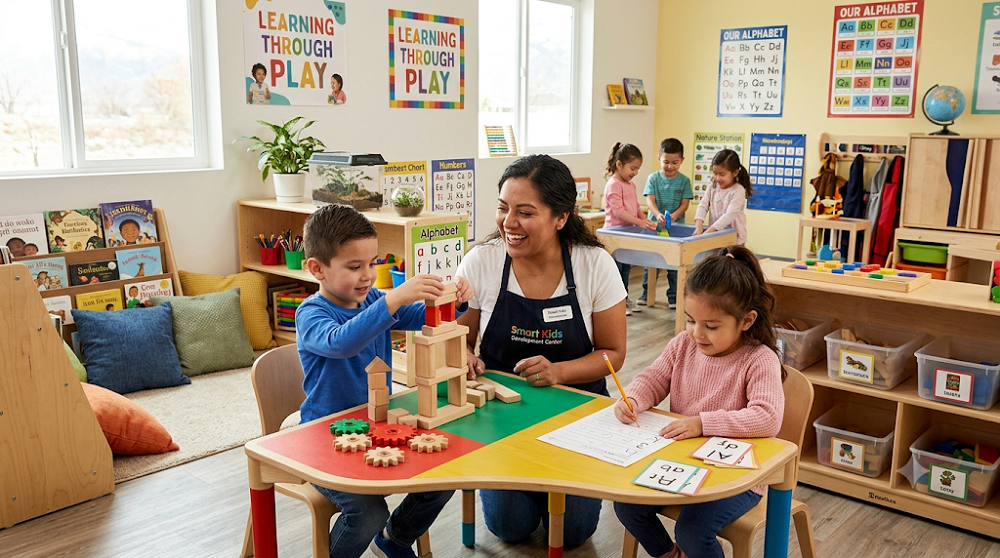
Choosing the right early education approach for your child can feel overwhelming for parents in Salt Lake City, Utah. The debate over academic vs play-based preschool programs often leaves families wondering which style best prepares a young child for long-term success.
The ideal preschool experience does not force a choice between structured lessons and free play. Instead, blending structured academic learning with open-ended play creates a balanced environment where children build essential cognitive skills while developing social confidence, creativity, and a lifelong love for learning. And at Smart Kids Development Center, we promote both these approaches and a careful balance between the two. Read on to learn more about this vital area, or contact us today to learn more about our programs or schedule a tour!
Understanding the differences between early childhood education models helps parents make confident decisions for their family.
When comparing preschool philosophies, it helps to look at how each approach structures a typical school day. Academic-focused preschools center on teacher-led instruction designed to teach specific skills. Activities often include tracing letters, learning phonics, counting numbers, and following structured group schedules. The primary goal is building direct academic familiarity before kindergarten.
In contrast, play-based preschools center on child-initiated activities. Learning happens through hands-on discovery, sensory stations, building blocks, and imaginative play. Teachers act as facilitators who guide learning opportunities as children interact with their environment. Rather than sitting through formal lessons, children explore concepts like gravity, volume, and cooperation through direct play experiences.
Both educational philosophies offer distinct advantages that contribute to early child development. Academic learning introduces children to structured routines, listening to instructions, and mastering early academic milestones. Children gain confidence as they learn to recognize letters, count objects, and write their names.
Play-based learning fosters social-emotional intelligence, critical thinking, and fine motor skills. When children build a block tower together or engage in dramatic play, they practice negotiation, sharing, and self-regulation.
| Learning Approach | Core Focus Areas | Key Benefits Developed |
| Academic-Focused | Phonics, early literacy, counting, teacher-led routines | School familiarity, pencil grip, early math and reading skills |
| Play-Based | Exploration, sensory play, imaginative games, and social interaction | Problem-solving, emotional regulation, creativity, teamwork |
| Blended Approach | Guided play, interactive storytelling, hands-on math, group learning | Holistic development, academic readiness, and enthusiasm for school |
Focusing exclusively on one style can leave gaps in a child’s early development. A heavily academic environment may cause stress or burnout if a young child is not developmentally ready for prolonged sitting. On the other hand, an entirely unstructured play environment might leave a child needing more practice with classroom expectations when entering kindergarten.
Finding a balance ensures children develop both intellectual capability and emotional maturity. Combining foundational academics with plenty of creative movement and play respects natural early childhood development stages. Children learn best when they are active, curious, and emotionally supported.
High-quality preschool programs seamlessly merge structure and play throughout the daily routine. Teachers intentionally design learning centers where academic concepts are embedded in play activities.
By guiding play rather than dictating every action, teachers maintain high engagement while checking key developmental milestones.
Smart Kids Development Center provides early childhood education to families in Salt Lake City, Utah, and nearby communities. Our program integrates structured academic learning with rich, play-based exploration to prepare children for kindergarten while keeping learning fun and natural.
Most children benefit from starting a structured program between ages two and a half and three, depending on their individual developmental readiness and social comfort.
Observe how your child reacts to routine tasks and independent play. Children who struggle with self-regulation or sharing often thrive with play-based activities, while children eager to write letters or solve puzzles enjoy gentle academic challenges.
Yes. Quality play-based and blended programs align activities with Utah early learning standards, ensuring children build the language, math, and social skills required for kindergarten success.
Our experienced educators tailor daily activities to match the developmental needs of every child, ensuring they build confidence, strong social connections, and essential academic skills. To explore our classroom environments and learn more about our curriculum, contact Smart Kids Development Center today to schedule a tour or review our preschool programs.

